
A Comprehensive Comparison Plotted Development vs. Buying Open Land
Before making any decision, focus less on the price per square foot and more on the quality of the asset behind it. In real estate, the safest investment is rarely the cheapest one. It is the one that is prepared for tomorrow.
Real estate broadly has always been a go to tested asset class for building wealth in India. However, regarding land ownership and property dealership, a common concern for buyers is whether to opt for a planned plotted development or buy plot land.
Open land may seem more appealing initially, due to lower entry level price points and larger lots. Nonetheless, you cannot define safety in real estate using price only. Instead, elements like legal clarity, infrastructure maturity, hope of adaptation down the line and compliance/regulatory risk are far more significant to long-term value preservation.
So, which option offers greater security for today's buyer? Let's understand the difference.
Understanding the Two Choices
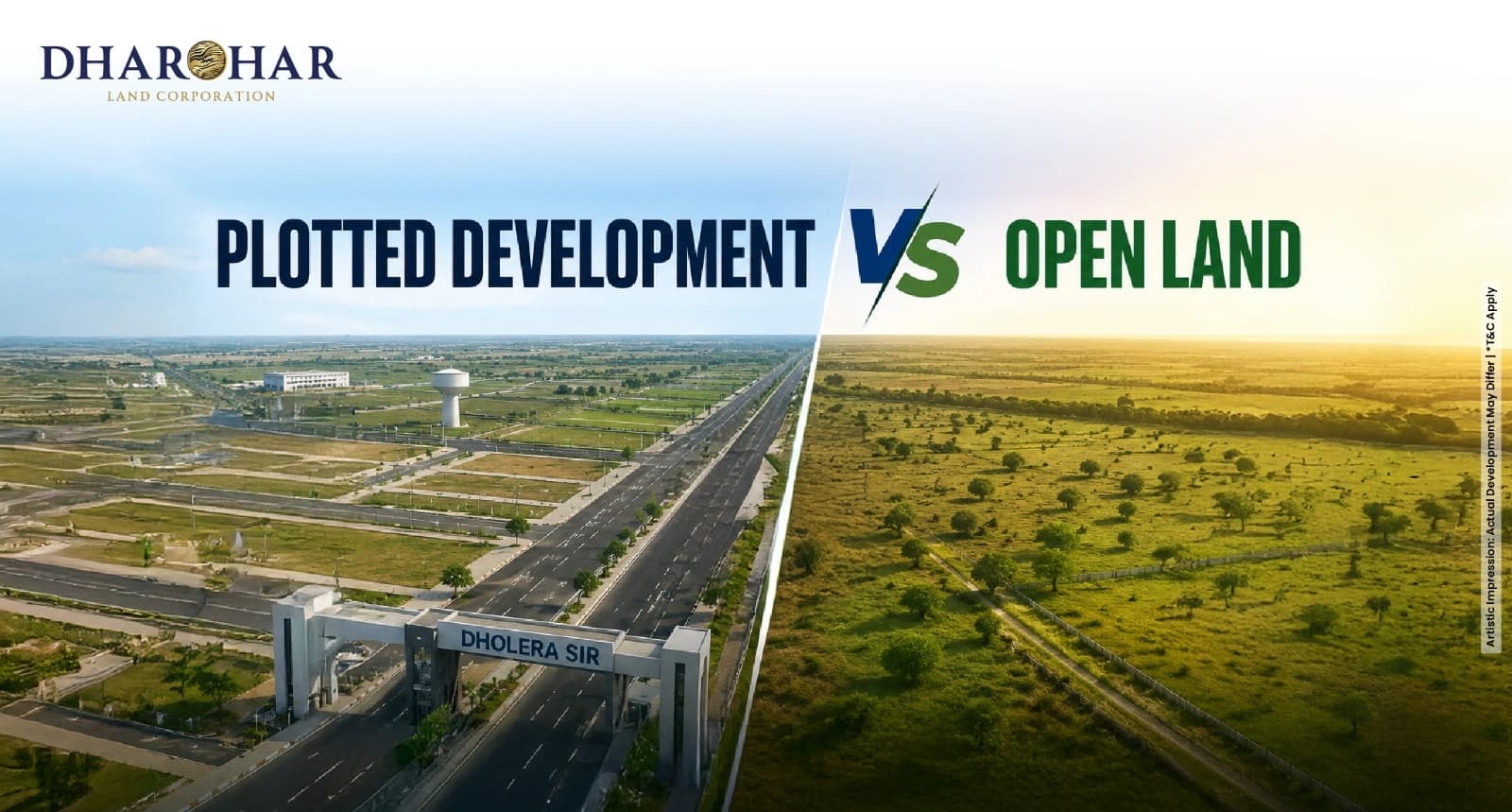
Open land refers to plots of undeveloped land that might not have roads, utility connections, or drainage systems in place or state-sanctioned plans for construction. Often, this land is bought with the hope of development around it in the future that will make it more valuable.
In contrast, plotted development is generally part of an organized layout with demarcated land parcels provided with basic infrastructure, including internal roads, drainage systems, electricity connections, and approved layouts.
Both paths involve land ownership, but the level of preparedness and risk may be very different.
The Legal Security Factor
Title clarity is one of the most important concerns of land transactions. Purchasing property on open land involves the home buyer having to ascertain the property title chain, land use authorizations, access rights, and any disputes associated with the land. A lack of documentation – even the smallest gaps – can lead to problems later. Plotted developments tend to be more structured since documentation and plans for the development are typically planned for sales. Project approvals, land, and regulatory registrations are often more easily brought to the buyer's attention. However, it is always advisable to cross-check any documentation, whether it is purchased already or not.
Infrastructure Changes Everything
Land value is closely linked to infrastructure. Plotted developments reduce some of this uncertainty because foundational infrastructure is usually incorporated into the project design from the beginning.
Whether it is planned or speculative, buyers are now focusing on planned developments in the areas where large scale infrastructure projects are already in the execution phase across India.
An example is the Special Investment Region (SIR) of Dholera in Gujarat, which is undergoing continuous transformation with the development of infrastructure and the growth of industry.
Some of the recent developments include work on the Ahmedabad–Dholera Expressway, the upcoming international airport, trunk infrastructure networks, and big semiconductor manufacturing facilities.
The developments are contributing to the development of an ecosystem of connectivity, utilities, logistics and employment.
A major landmark was reached in 2026 as the government provided notification to a Special Economic Zone for the fabrication plant of Tata Semiconductor Manufacturing (TSM), which will have an investment of approximately ₹91,000 crore and create around 21,000 jobs.
Meanwhile, Gujarat Budget 2026-27 provided Rs 610 crore for the development of trunk infrastructure in the region, comprising roads, water, utilities, and digital infrastructure.
The key factor in today's real estate investment is that buyers are shifting their focus from future predictions to the tangible infrastructure delivery, industrial activity, and long-term urban planning of a location.
Planned developments tend to offer more clarity in these settings on connectivity, usability, and development prospects.
Flexibility vs Predictability
Supporters of open land often highlight flexibility.
Owners may have more freedom in how they hold, utilize, or eventually develop the land, subject to local regulations.
The initial acquisition cost can also be lower compared to organized developments.
However, lower cost frequently comes with additional responsibilities.
Buyers may need to arrange access roads, utility connections, fencing, approvals, and legal verification on their own.
Plotted developments typically provide greater predictability. Boundaries are clearly marked, layouts are defined, and infrastructure planning is already considered. This can make future construction, resale, and financing more straightforward.
What Should Buyers Check?
Regardless of the option selected, certain checks should never be skipped:
· Verify ownership and title history.
· Review land-use permissions and zoning status.
· Confirm access-road legality.
· Check layout approvals and regulatory registrations wherever applicable.
· Examine infrastructure availability and future development plans.
· Review encumbrance records and relevant legal documents.
Many experienced buyers consider these steps essential because even promising locations can carry hidden legal or regulatory risks if due diligence is ignored.
The Role of Regulatory Compliance
India's real estate sector has become increasingly transparent due to regulatory frameworks such as RERA. Project registration requirements, disclosure norms, and buyer-protection measures have improved accountability across many organized developments.
While regulatory compliance does not eliminate every risk, it provides buyers with additional information and mechanisms for grievance redressal. This is one reason why many purchasers prefer projects where approvals and documentation are more easily accessible.
Conclusion
If the objective is maximum flexibility and the buyer has the expertise to conduct extensive legal and technical verification, open land can present opportunities.
However, for most buyers seeking a balance of security, usability, infrastructure readiness, and documentation transparency, a well-planned plotted development often offers a safer and more structured path.
The key takeaway is simple: land itself does not create value—planning, infrastructure, legal clarity, and future connectivity.
Before making any decision, focus less on the price per square foot and more on the quality of the asset behind it. In real estate, the safest investment is rarely the cheapest one. It is the one that is prepared for tomorrow.
