
Renewable Energy + Smart City Dholera's Dual Growth Engine Explained
Dholera represents something genuinely rare in urban development: a city where the energy model, the infrastructure model, and the economic model were designed together rather than assembled separately over time.
What if a city could be born already knowing the future?
Not retrofitted. Not patched up after decades of poor planning hardened into concrete and corroding pipelines. But designed, from the first survey in the ground, with solar farms feeding intelligent grids, industrial corridors powered by clean energy, and urban infrastructure that doesn't just serve today's needs but anticipates tomorrow’s.
That city is Dholera. And it's being built right now, approximately 100 kilometres southwest of Ahmedabad, on a sun-drenched expanse of Gujarat that most of India is only just beginning to pay attention to.
Urban planners, infrastructure economists, and policy researchers watching Dholera closely often draw comparisons to Singapore in its formative decades, not because the geographies match, but because the intent does. Dholera is India's first greenfield smart city, and arguably the world's most deliberate attempt to fuse renewable energy infrastructure with urban development at the blueprint stage, not as a sustainability add-on bolted on later.
That distinction is everything.
Two Engines. One Integrated Vision.
Every functioning city runs on energy. The question that determines a city's long-term competitiveness has always been: what kind, at what cost, and how reliably?
Dholera's answer is already engineered into its geography. The Dholera Special Investment Region (DSIR) sits within Gujarat's high-potential renewable energy zone, one of the strongest solar irradiation belts in Asia. Annual average irradiation in this region reaches approximately 5.5 to 6 kWh per square metre per day. That isn't incidental. It's a foundational infrastructure advantage that city planners have actively built around.
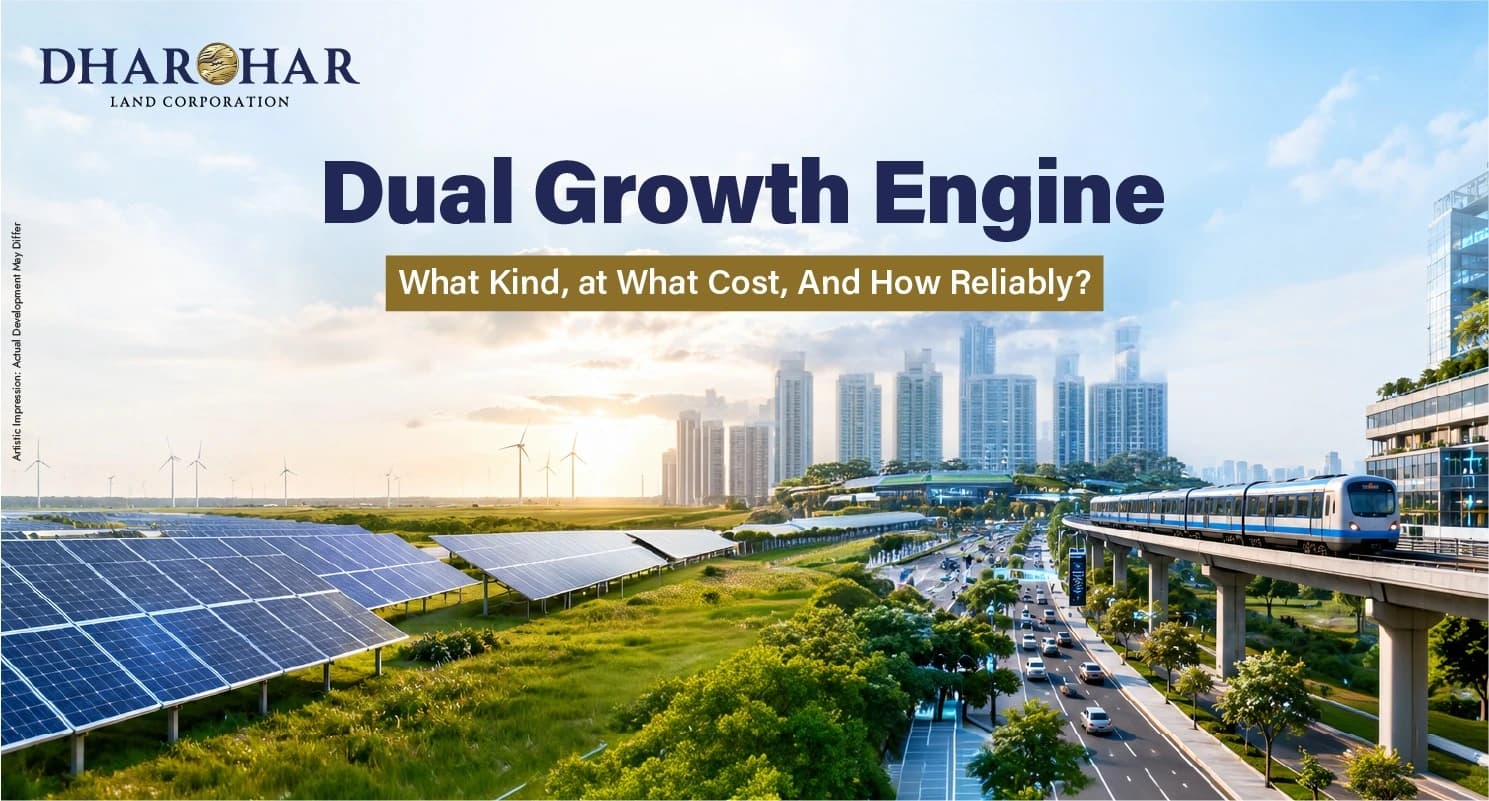
The Dholera Solar Park, spanning roughly 5,000 acres, is designed with a capacity of up to 5,000 MW of solar power generation. Critically, this energy isn't being routed elsewhere. It is being integrated directly into Dholera's smart grid, the central nervous system that will power everything from its industrial manufacturing zones to its residential and commercial sectors.
This is the dual engine at work: large-scale renewable energy generation powering a purpose-built smart city ecosystem, with each component reinforcing the other's long-term viability.
Why This Combination Is Structurally Significant
Clean energy initiatives and smart city projects have existed in parallel before, in Masdar, Copenhagen, and parts of South Korea. What makes Dholera different is the scale of industrial ambition matched with energy self-sufficiency from day one.
The DSIR spans over 920 square kilometres, making it roughly twice the size of Mumbai. It is a designated node along the Delhi-Mumbai Industrial Corridor (DMIC), India's flagship infrastructure development programme, which means it carries sovereign institutional commitment, long-term capital allocation, and active multinational interest.
Industries evaluating locations for semiconductor fabrication, defence manufacturing, electric vehicle assembly, and large-scale data infrastructure are increasingly factoring energy costs and reliability over multi-decade horizons. A smart city running on a stable, renewable-powered grid presents a fundamentally different operational calculus than a conventional industrial estate dependent on grid volatility or carbon-intensive sources.
Dholera's infrastructure blueprint also includes a command-and-control centre for city management, an integrated traffic system, underground utility corridors, a treated water recycling network, and high-speed fibre connectivity, all planned as standard features, not upgrades.
Connectivity Completing the Picture
A smart, energy-independent city still needs physical connections to function at scale. Dholera's connectivity infrastructure has been developing steadily on this front.
The Ahmedabad-Dholera Expressway has significantly reduced travel time between the two cities. The upcoming Dholera International Airport, planned as a greenfield facility, is designed to support both passenger and cargo operations, which is particularly relevant for the export-oriented manufacturing clusters taking shape within the DSIR.
Together, road, air, and eventually metro rail connectivity form the third layer of Dholera's growth framework, alongside renewable energy and smart urban systems.
The Larger Significance
Dholera represents something genuinely rare in urban development: a city where the energy model, the infrastructure model, and the economic model were designed together rather than assembled separately over time.
The renewable energy foundation isn't a sustainability badge. It's a long-term cost and reliability advantage for the industries, institutions, and communities that will eventually call Dholera home.
India has built industrial zones before. It has built solar parks before. It has announced smart cities before.
Dholera is the first serious attempt to build all three as a single, coherent system, and that is what makes it worth understanding.
