
The Difference Between Buying Land & Investing in land
Smart land investing starts long before the cheque is written. It starts with asking better questions.
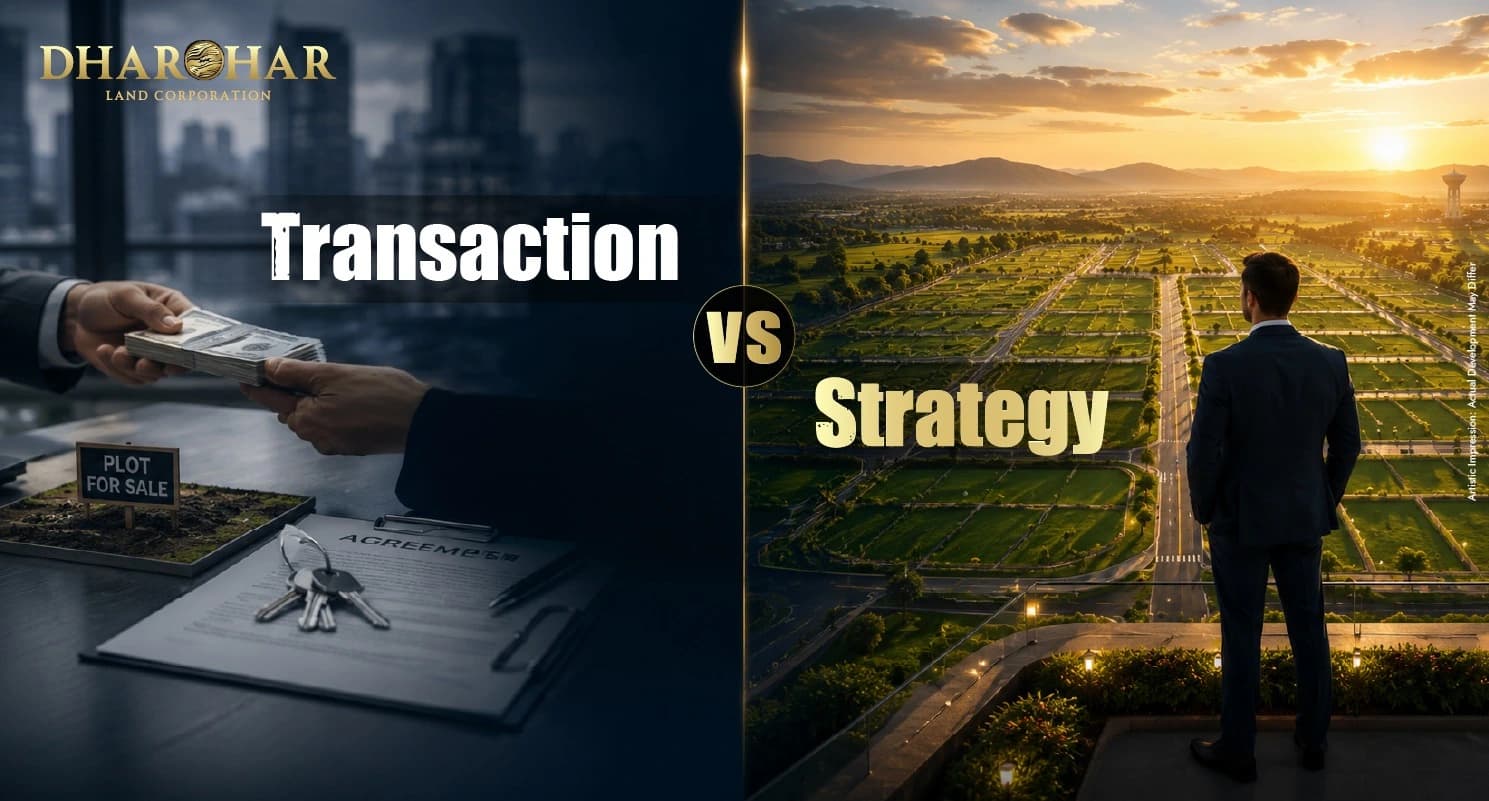
Same Plot, Very Different Story
Two friends, Rajan and Vikram, bought plots the same weekend. Same location, same size, same price.
Three years later, they're in very different places.
Rajan bought because his relatives were buying.
He visited once, signed the papers, done. No title check, no master plan review, no exit thought whatsoever.
The plot still sits idle, and he recently discovered some document irregularities he didn't see coming.
Vikram spent three weeks before signing anything. He checked the master plan, verified infrastructure timelines, got a lawyer to review the title chain, and thought through when and how he'd eventually sell.
Both men bought land. Only one of them invested.
That gap between a transaction and a strategy is what this written piece is about.
Owning Land Isn't the Same as Investing in It
Here's the truth: land ownership is a legal status.
Land investment is a discipline.
The two can absolutely go together, but one doesn't automatically produce the other.
When you buy based on what's available, what feels right, or what everyone else is doing, you're acquiring an asset.
But you're not necessarily building wealth.
You own something. What you don't have is a clear answer to why it should be worth more in the future and when.
That's the question investors start with:
Why will this location matter down the line?
It sounds simple, but answering it requires real work:
Understanding infrastructure plans, government policy direction, regional demand, and a location's long-term arc.
It also means being honest with yourself about risk, timeline, and exit.
Buying Land vs Investing in Land
There are numerous aspects one should evaluate before buying or investing in land. The level of attention to detail and due diligence often defines the difference between simply buying land and strategically investing in land.

So What Does an Investor Actually Look At?
It starts with the title.
“The difference in outcomes usually comes down to the difference in inputs.”
The baseline: A clean, unencumbered title with a clear ownership chain.
From there, you're looking at approvals, land use designations, encumbrance certificates, any litigation history.
Not assumed to be fine but actually checked.
Then comes the infrastructure question.
Roads, utilities, metro plans, industrial zones, logistics corridors, anything that could structurally change the demand picture for that location over time.
Government-backed projects carry a very different weight here than developers promise.
Connectivity matters, not just today, but five to ten years out.
Where's the highway extension going?
Is there any planned connectivity?
These forward-looking factors often shape a location's fundamentals more than its current state.
Entry timing is real too.
Getting into a credibly backed, infrastructure-driven location early can be meaningful, but it also means sitting with illiquidity for longer.
That's not a problem if you've planned it.
It's a big problem if you haven't.
And then there's exit.
Before you invest, you should have at least a rough idea of how you get out, who the likely buyer is, when demand might peak, and what conditions would make the sale viable.
No guarantees, obviously. But the question has to be on the table.
The Way People Are Investing in Land Is Changing
Something has shifted in the last decade.
The land investor who used to rely on a tip from a relative or a broker's enthusiasm is increasingly being replaced by someone who wants verified documentation, master plan access, and a clear location thesis before signing anything.
You can see this shift in the kind of locations that attract serious attention.
Dholera SIR, for instance, a planned greenfield smart industrial city under the Delhi–Mumbai Industrial Corridor framework, spread across roughly 920 square kilometers has drawn growing interest from investors who are specifically looking at infrastructure-backed, long-horizon locations.
It's not hype-driven interest.
It's the kind that comes from reading government plans and thinking in decades, not months.
That broader change:
« From gut feeling to due diligence
« From transaction to strategy
« Demand for better guidance and verified opportunities in the land space
As the approach becomes more research-driven, investors are looking for partners who bring both depth and transparency to the table.
Where land becomes legacy, not just an entry in a property register.
To Wrap Up
A buyer asks:
What land am I buying?
An investor asks:
Why will this location matter in the future?
That gap is where wealth gets created or quietly missed.
Land rewards patience and preparation.
It's not particularly forgiving of impulse.
Due diligence isn't a formality.
It's the actual job.
Title clarity, infrastructure backing, location logic, exit planning, these are what separate a sound portfolio decision from a plot that just sits there collecting dust.
“Smart land investing starts long before the cheque is written. It starts with asking better questions.”
For secure land investment opportunities, contact Dharohar Land Corporation.
