
What If ‘Too Early’ Becomes your Biggest Investment Advantage!
Dholera SIR is increasingly becoming one of those infrastructure-led stories where connectivity, planning, and industrial momentum are steadily reshaping perception.
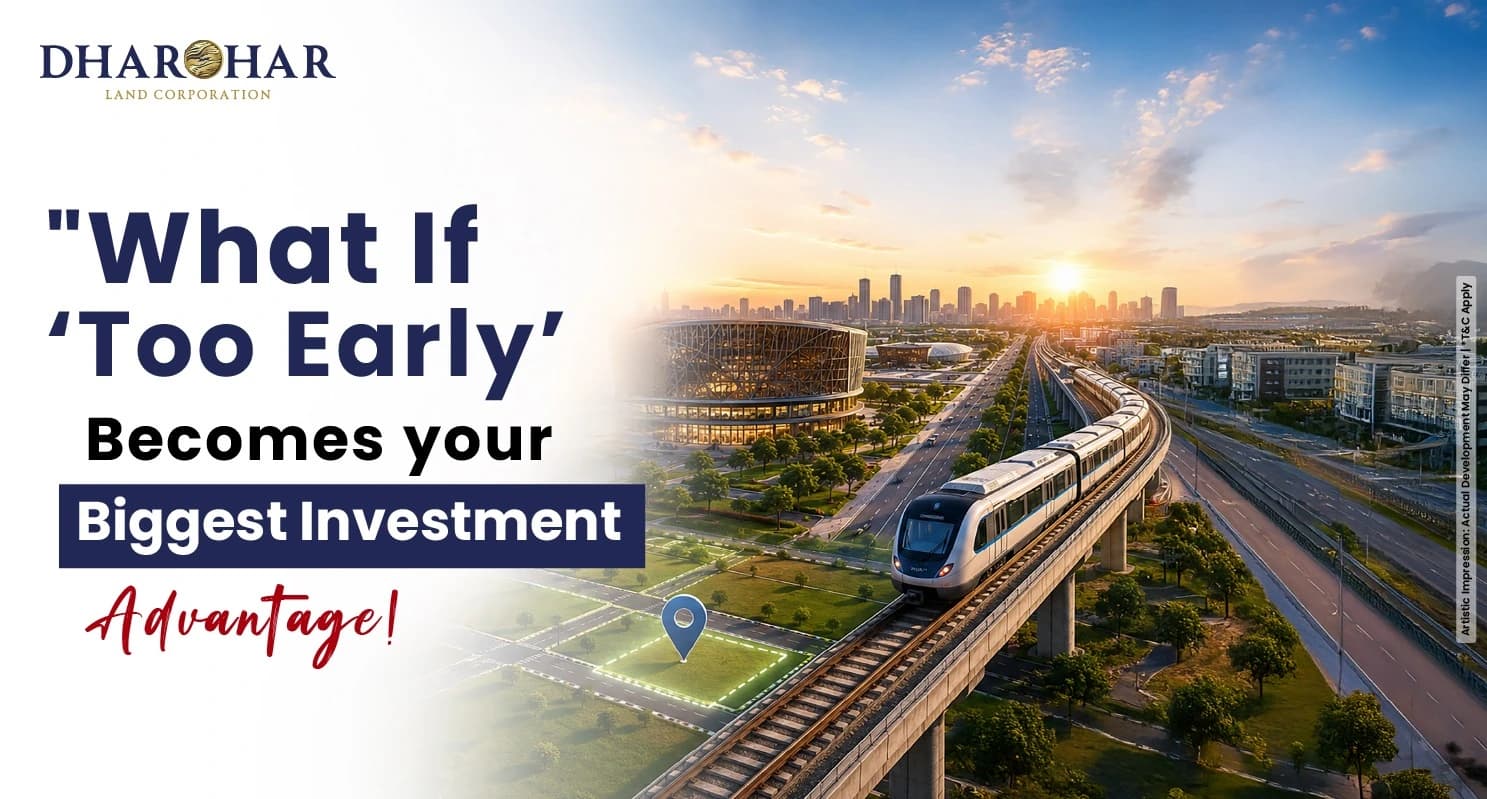
How Metro rail to Dholera SIR once termed "Far Away," Will End Up Being Gujarat's Smartest Investment!
Three years ago, an entrepreneur from Ahmedabad bantered with his best friend for buying a land in Dholera, SIR.
"Who's going all the way?"
Not a single trace of malls, high-rise buildings, or city was a vision most people couldn’t yet see.
Today, the entrepreneur is hypervigilant and tracks every major connectivity update of Dholera.
Because something changed.
Not the land.
The access to the land.
And in real estate, that changes everything.
The Biggest Lie in Real Estate?
“Far Away Land Never Wins.”
History says otherwise.
Every major growth corridor once looked “too far.”
· Gurgaon once felt disconnected from Delhi.
· Navi Mumbai once felt secondary.
· GIFT City once sounded overly ambitious.
· Peripheral Hyderabad was once “empty land.”
Then the infrastructure arrived. Followed by Metro lines, Expressways, Transit corridors and Airports. All at once, the city grew wider than its city walls. And land prices followed. That's the trend investors are observing at Dholera SIR. Connectivity isn't just about cutting down travel time. It changes the dynamics of the market.
Why Metro Connectivity Is a Bigger Deal Than Most Investors Realize
Why Metro Connectivity is More Important than it Seems to Investors
It’s not. It's the subject of economic migration.
When fast urban connectivity arrives at a developing corridor:
· Staff have access to better transport to and from work.
· Businesses expand confidently
· Residential demand rises
· Commercial ecosystems follow
· Investors go on offense!
What was the most significant change? The space that was once out of town becomes a part of the city's future. It is at that psychological switch that land values begin to soar.
The Hidden Rule of Wealth Creation in Land
Here’s what experienced investors comprehend:
Land gets overpriced when connectivity becomes obvious.
Not before.
The real money is usually made during the transition phase:
· With visible infrastructure
· However, mass public confidence is under scrutiny
This is the "sweet zone. And the reason why transit-led regions generate out-sized opportunities.
The “20-Minute Rule” That Changes Real Estate Forever
There’s a silent rule in urban development:
Once a place is accessible within a reasonable traveling time, demand will increase dramatically.
Nobody wants “far.”
People want “accessible.”
Hence, the metro and rapid connectivity projects influence the region as a whole. A place psychologically transforms into:
· “isolated” to
· “future-ready”
But once that's in place, investors begin bidding for early bookings.
Dholera Is Not Growing Like a Traditional City
This is where most people misunderstand Dholera SIR.
Dholera is not expanding randomly.
It is being built through layered infrastructure planning:
· Ahmedabad–Dholera Expressway
· DMIC integration
· Smart industrial zoning
· Large-scale utility infrastructure
· Industrial and semiconductor ecosystem development
· Future-focused transit connectivity
This matters because infrastructure-backed cities grow differently from speculative real estate pockets.
They grow systematically.
And systematic growth creates long-term land demand.
What Urban Connectivity Actually Does to Peripheral Land Markets
The impact happens in waves.

Every single major growth corridor follows this emotional cycle.
The problem?
Most people enter only in the final phase.
Why Emotion Makes Investors Miss Big Opportunities
Human beings naturally seek certainty.
That’s why most buyers wait for:
· finished roads
· crowded markets
· visible commercial activity
· rising prices
· social proof
But certainty comes at a cost.
The more obvious a location becomes, the smaller the opportunity window usually gets.
That’s why early-stage infrastructure investing feels uncomfortable.
And that discomfort is often where disproportionate wealth gets created.
Connectivity Creates More Than Transportation
It Creates Economic Gravity
This is the part most investors underestimate.
When transit and infrastructure improve:
· industries arrive
· logistics strengthen
· housing demand rises
· workforce migration increases
· retail expands
· institutional investment follows
Connectivity creates gravity.
And gravity attracts money.
That’s exactly why regions around major transit and industrial corridors historically outperform disconnected land pockets over long time horizons.
The Investor Divide Is Becoming Very Clear
Today, there are two kinds of land buyers.
Buyer Type 1:
Looks at land emotionally.
· “What exists today?”
· “Does it feel developed already?”
· “Would I personally live here now?”
Buyer Type 2:
Looks at land strategically.
· “What infrastructure is coming?”
· “How will connectivity reshape demand?”
· “What happens here in 10 years?”
The second investor usually wins.
Because land investment is not about buying today’s reality.
It’s about buying tomorrow’s relevance.
The Smartest Investments Often Begin as Doubts
The funny thing about transformational locations is this:
They rarely look transformational in the beginning.
They look incomplete. Underestimated. Early.
Until suddenly, they aren’t.
Dholera SIR is increasingly becoming one of those infrastructure-led stories where connectivity, planning, and industrial momentum are steadily reshaping perception.
And history repeatedly shows one truth about land investing:
The biggest opportunities are usually discovered before the crowd feels comfortable.
Because in real estate, the future rarely rewards the people who arrived last.
It rewards the people who understood connectivity before everyone else did.
